








Esta web utiliza cookies para que podamos ofrecerte la mejor experiencia de usuario posible. La información de las cookies se almacena en tu navegador y realiza funciones tales como reconocerte cuando vuelves a nuestra web o ayudar a nuestro equipo a comprender qué secciones de la web encuentras más interesantes y útiles.
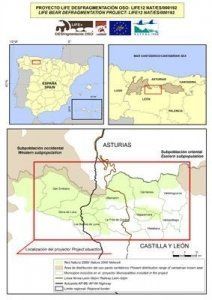
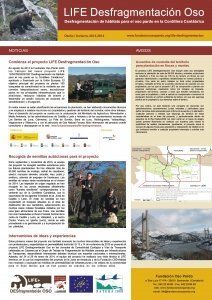
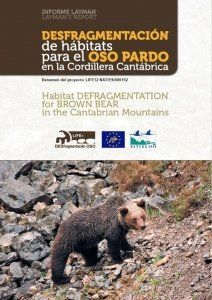
The project LIFE12 NAT/ES/000192 “Habitat defragmentation for Brown Bear in the Cantabrian Mountains”is been developed by the Brown Bear Foundation (Fundación Oso Pardo, FOP by its initials in spanish) from August 2013 to December 2016 in the interpopulation corridor between the two Cantabrian brown bear subpopulations.
Defragmentation of bear corridors
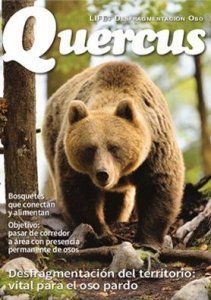
Habitat fragmentation is, together with direct anthropogenic mortality, the main cause of decline or extinction of many bear populations. Besides the destruction of good quality habitat, especially large forest, highways, roads and big linear infrastructures are responsible for population fragmentation as they are a real barrier and can create an avoidance area in its surroundings. Although bears can move easily along big distances, usually only young males disperse, while young females tend to stay close to her mothers home range. This situation makes more likely the isolation of reproductive nuclei by linear barriers as big roads or highways, complicating genetic and demographic interchange and the colonization or recovery of reproductive areas and ultimately threatening the population viability and survival.
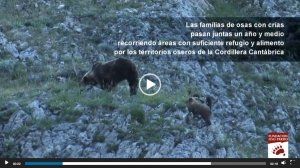
In the Cantabrian Mountains there are about 200 bears and its numbers are recovering from mid 90’s after the decrease suffered in the second part of the XX century. Cantabrian Brown bears are divided into two subpopulations fairly isolated from a genetic point of view and separated by a 50 km-wide area known as interpopulation corridor, sporadically used by the bear as the evidences show almost every year. This corridor is crossed by a highway and some roads and railways and has suffered a heavy deforestation in the southern part. Even so, the corridor habitat has a good quality and data increasingly indicate the presence of bears in the corridor linking the two subpopulations.
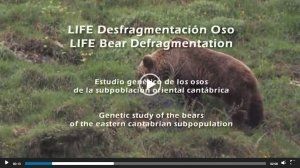
Through the use of genetic analyses it has been shown that some males have moved between subpopulations, and one “western” male was recently found to have bred with an “eastern” female, producing two “mixed” cubs.
In the current situation, with both Cantabrian bear subpopulations increasing its numbers, the main conservation goal is the effective connection between them, strengthen the emerging movement of bears detected in this years. For this reason, actions for the defragmentation and improvement of connectivity as those foreseen in the LIFE project Defragmentation Bear are of priority interest for the future conservation of bears in the Cantabrian Mountains.
More information about current situation of brown bear in the interpopulation corridor and the advisable actions for the improvement of connectivity, can be found in the “Best Practices Handbook for Bear Corridor Management in the Cantabrian Mountains”, published by Brown Bear Foundation in a previous LIFE project and available as pdf here (in Spanish).
Beneficiary

Economic support

Collaborators
Action area of the project
El Life in action
Links of interest
Esta página web ha sido realizada con la contribución financiera del programa LIFE de la Unión Europea.
La información recogida en esta página web refleja únicamente el punto de vista de los beneficiarios del proyecto LIFE Oso Courel. Ni la Agencia Ejecutiva para las Pequeñas y Medianas Empresas (EASME) ni la Comisión Europea son responsables por cualquier uso que pueda realizarse de la información contenida en esta web.
This website has been made with the contribution of the LIFE Programme of the European Union.
The information included in this website reflects only the view of the LIFE Oso Courel beneficiaries. Neither the Executive Agency for Small and Medium-sized Enterprises (EASME) nor the European Commission are responsible for any use that may be made of the information it contains.