
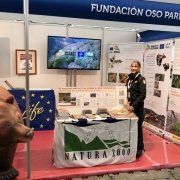
LIFE Bears with Future at the Naturcyl Ecotourism Fair. September 2021

Between September 24 and 26, the fourth edition of the Castilla y León International Ecotourism Fair, NATURCYL, was held in the town of Ruesga, in the Montaña Palentina. The Brown Bear Foundation (FOP) has participated in the fair offering information to visitors about the ‘LIFE Bears with Future’ project. At the FOP stand, visitors have been able to learn about the actions aimed at improving the availability of food for bears through the planting of native wild fruit trees and the forest treatment of oak and chestnut groves, with the aim of helping the adaptability of the brown bear to climate change in the Cantabrian Mountains.

The Fair, which has had 85 exhibitors from all over the national territory, has been visited by 10,500 people, attracted by the exhibitions and activities related to the enjoyment of nature and the outdoors, in a wide spectrum of possibilities, such as rural tourism, wildlife observation, nature photography, hiking, mountains, astrotourism, routes, rural life, etc.

The ‘LIFE Bears with Future’ project is coordinated by the Brown Bear Foundation and has as beneficiaries associated the Biodiversity Foundation (Spanish Ministry for the Ecological Transition and the Demographic Challenge) and the Natural Heritage Foundation (Junta de Castilla y León). The regional administrations of the Junta de Castilla y León and the Principality of Asturias collaborate in the project, and Fundación Tierra Pura and the Principality of Asturias also contributes to the co-financing.


Visitors to Naturcyl Fair listen to explanations about the ‘LIFE Bears with Future’ project.
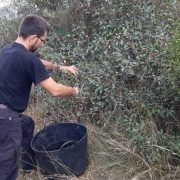
First collection campaign of Alder Buckthorn seeds. September 2021

The Alder Buckthorn (Frangula alnus) is a deciduous shrub or tree that produces fleshy fruits that are highly valued by the brown bear and other frugivorous species. It generally appears in riparian forests, fresh hedges, birch forests, borders and oak forest clearings and rocky areas on neutral or acidic soils. It has a great capacity for regeneration, very fast growth and good productivity, making it a very interesting species in the enrichment small forest plantation model proposed in the ‘LIFE Bears with Future’ project.

In September 2021, the LIFE project field team held several days to collect fruits of this species in areas of the municipality of Cabrillanes (León) and the councils of Ibias and Degaña (Asturias), avoiding access to the most visited by bears at the same time. A total of 11 kg of fruit has been collected. Although it is not a species regulated by Royal Decree 289/2003 on the commercialization of forest reproductive materials, suitable stands have been selected within the project’s area of action and the fruits have been adequately labeled and transferred to the Central Forest Nursery of the Junta de Castilla y León, where the seeds will be cleaned and prepared for plant production.

This autumn there has been a very low and irregularly distributed production of Common Whitebeam fruit (Sorbus aria), another species of interest in the project. The different official seed sources established for this species have been evaluated, detecting a great shortage of fruit. Years with low production also tend to give rise to seeds with low viability and low germination rates, which is why it has finally been decided not to collect Common Whitebeam fruits and wait for a year with high fruit production.


Field technician of the ‘LIFE Bears with Future’ project collecting Alder Buckthorn seeds (Frangula alnus)