
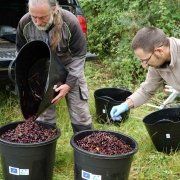
First cherry seed campaign collection. June 2021

One of the main species to be planted in the trophic enrichment forests foreseen in the ‘LIFE Bears with Future’ project is the cherry tree (Prunus avium). To begin with the production of locally sourced seedlings, in this month of June 2021, the project field team has collected 100 kg of cherry fruits in the north of León. The cherry tree is a regulated species, so it can only be planted from seeds collected in forest stands declared as an official seed source and all the seed collected in the different areas must be certified by the Castilla y León forest administration, to guarantee the suitability of the origin of the seeds and the traceability of the plant production process.

The cherry fruits have been collected in trees from the Seed Source FS/95/02/24/001, in the municipality of Cubillos del Sil (León), under the supervision of the environmental agents of the Junta de Castilla y León. The fruits have been transferred to the Central Forest Nursery of the Junta de Castilla y León, where the seeds will be cleaned and prepared for plant production. The amount collected will allow to obtain 50,000-60,000 seeds. We are evaluating the availability of fruit in other seed sources of the project area for future collections, and at the end of summer or during autumn we will proceed to the collection of other seeds of interest such as Alder buckthorn (Frangula alnus), Whitebeam (Sorbus aria), Strawberry tree (Arbutus unedo) and other species.

On July 21, the cherry seed collection was completed with another 40 kg collected by the LIFE project team at the Seed Source FS-95/04/24/023 in Villablino (León).


Field team of the ‘LIFE Bears with Future’ project collecting cherries for plant production.
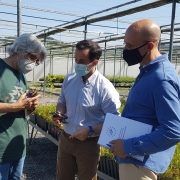
Agreement for the preparation of chestnut plants grafted with local varieties in La Mata Forest Nursery (Principado de Asturias). June 2021

After several meetings and preparatory work, on June 15, 2021 a working meeting was held at La Mata Forest Nursery (Grado, Asturias) for the organization and preparation of the chestnut plant production campaign for the project ‘LIFE Bears with Future’. David Villar, General Director of Natural Environment and Rural Planning of the Principado de Asturias, Eloy Ron, of the Society of Services of the Principado de Asturias and technical manager of the forest nursery, Pedro Álvarez, professor at the University of Oviedo, Fernando Ballesteros, project coordinator and member of the Brown Bear Foundation and Belén Garzón, Tragsatec technician, participated in the meeting.

The project ‘LIFE Bears with Future’ will plant 25,000 chestnut trees, of which about 20,000 will be chestnut trees grafted with local varieties from each area and the rest wild chestnut trees without grafting. As a very relevant contribution to the project, the Principado deAsturias government will produce 15,000 chestnut trees grafted with local varieties in La Mata Forest Nursery, without cost associated with the project.

The working meeting has allowed to establish the bases and define needs and roles in the production of chestnut trees, which will begin with the collection of seeds in official authorized Seed Sources in autumn 2021 by the technical team of the forest nursery. The LIFE project will provide technical support for grafting work, which can be done in the nursery and/or in the field once the planting is done, with the most appropriate techniques in each case. The project will also inventory and locate old chestnut trees grafted with different local varieties of interest, which can provide suitable plant material for grafting, considering aspects such as resistance to diseases, vulnerability to climate change or productivity and phenology of fruiting.


From left to right: Pedro Álvarez (University of Oviedo), David Villar, (General Director of Natural Resources and Rural Planning of the Principado de Asturias) and Fernando Ballesteros (Brown Bear Foundation), reviewing characteristics of seedling production in the Forest Nursery La Mata (Grado, Asturias).