• Twitter
  • Facebook
  • Instagram
  • Youtube
  • English English English en
  • Español Español Spanish es
ESPAÑOL
Fundación Oso Pardo
  • Home
  • WHO WE ARE
    • Management body
    • Our team
    • Our objectives
    • Results that leave a footprint
    • Legal regime
    • We are transparent
  • LEARNING ABOUT THE BROWN BEAR
    • The number of bears and where they live
    • Brown bear details
    • Not all brown bears are brown!
    • Tracks and signs
    • Bear landscapes
    • The repentant carnivore
    • Reproduction and family life
    • Hibernation
    • Bears and climate change
    • Encounters with bears
  • PROJECTS
    • LIFE Projects
      • Proyecto LIFE Human Bear Coex
      • Project LIFE bears with future
      • Other LIFE Projects
    • URSUS Program
    • HABITAT Program
    • Bear houses
    • FOOTPRINT Program
    • Bioeconomy: Chestnuts, Bears, and Rural Development
  • COLLABORATE WITH US
    • Donations and legacies
    • Become “Bears friend”
  • Publications
  • Supports
  • Search
  • Menu Menu

LIFE Bears with future

Review of the first plantings campaign of the LIFE Bears with Future project. October 2023

23 October, 2023

Review of the first plantings campaign of the LIFE Bears with Future project. October 2023

23 October, 2023/in LIFE Bears with future /by EditorFOP

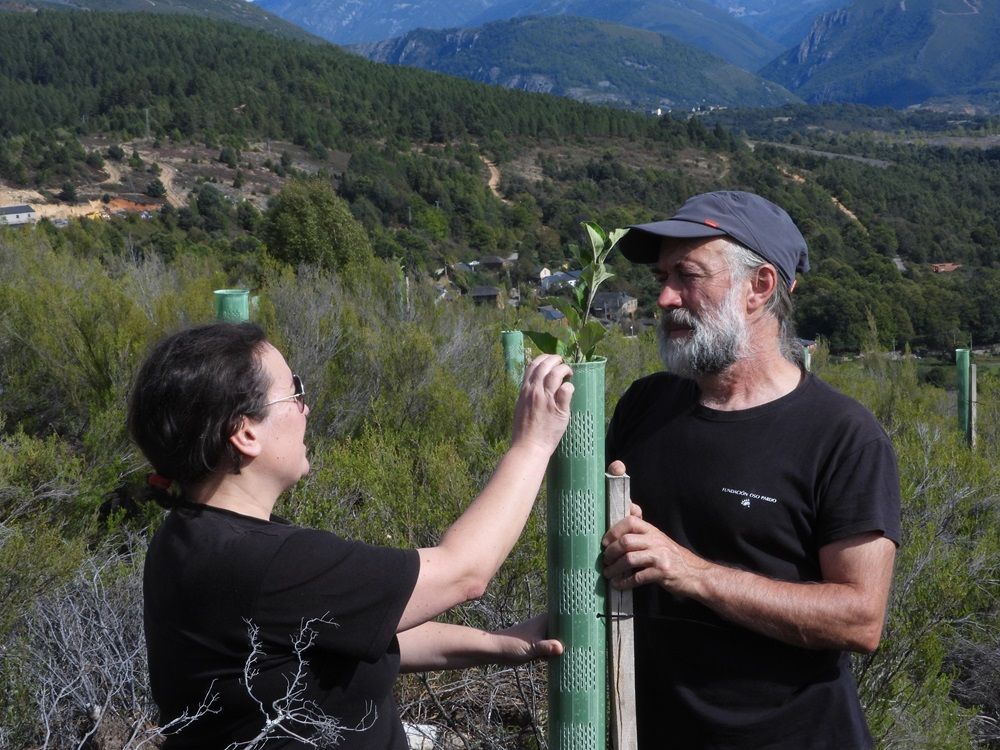
Checks of the tree plantations undertaken between last November and March as part of the first planting campaign of the LIFE Bears with future project, were made during September and October. During these checks, the percentage of successfully rooting plants was evaluated in order to apply the necessary corrections to the second planting campaign, currently underway.

The result has been very positive, with a success rate close to 90%, although it will be crucial to evaluate their continued development over the coming spring and summer seasons.

Summer 2023 saw a series of severe heatwaves in the area, leading to problems caused by insolation in the newly planted trees, which were further exacerbated by the long periods of drought also suffered by the area. Given that the models for the coming summers predict a worsening of these conditions, the selection of ideal locations for these plantations is fundamental. In this regard, terrain receiving less direct sunshine and with a degree of existing shrub cover to protect the newly planted trees from direct sunlight are selected, in addition to creating a microclimate which reduces evapotranspiration and also minimises the risk of browsing by herbivores. Minimal scrub clearance is only undertaken on a planted seedling by seedling basis in order to avoid excessive competition with the other woody species present.

The terrain reforested during the project’s first planting campaign complies with these criteria and the occurrence of a few small localised storms has contributed towards meeting the objectives.
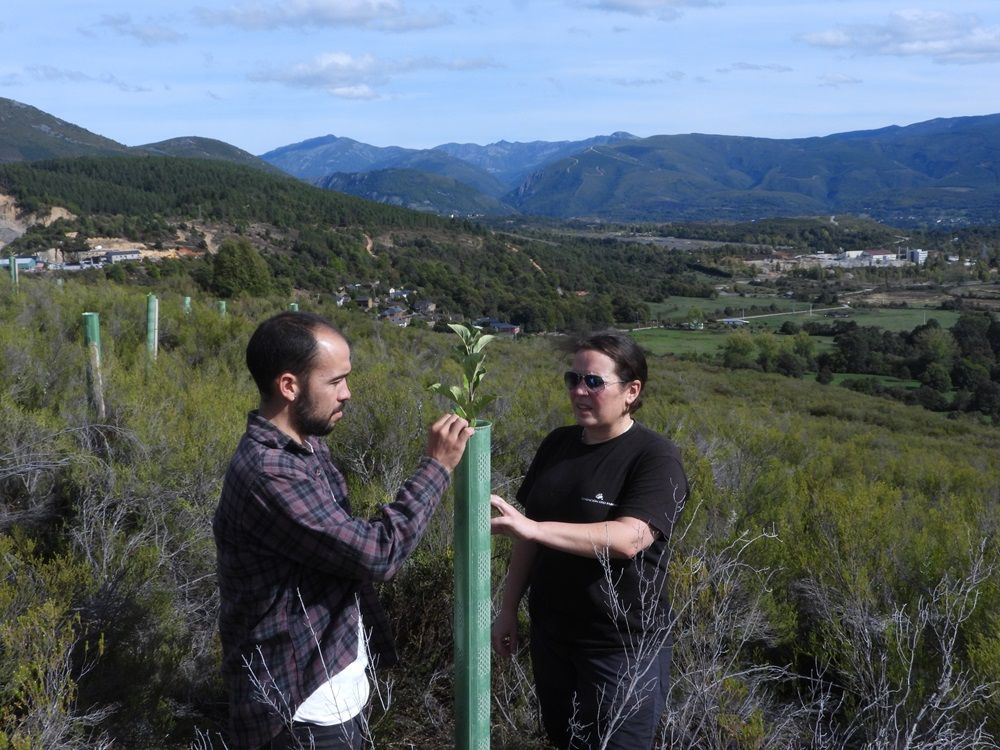
FOP staff checking a grafted apple in the Alto Sil area of León, within the framework of the LIFE Bears with future project.

Furthermore, the sweet chestnut trees grafted last spring in the La Mata Forestry Nursery of the Principality of Asturias were checked and which currently continue to grow. These were grafted with eight different local varieties from the project area (Parede, Chamberga, Galliciana, Naveixa, Palaciana, Panchina, Pelona and Vaquera). Some of these varieties are already under-represented in the region, such that the grafting work to recover these varieties is of high scientific and practical value for their recovery and conservation.

These traditional varieties of sweet chestnut are in the process of being lost, as was graphically illustrated by the genetic study of the surveyed trees at the start of the project. These trees were also in a poor condition and their survival is not guaranteed in the middle term. During the first phase, buds from genetically identified sweet chestnuts were collected for grafting in the nursery.

Part of the revision process in the nursery has consisted of the elimination of suckers from the grafted sweet chestnuts in order for the seedlings to invest all of their energy in growing the grafted section. Extreme precautions were taken in the cleaning and sterilization (using a bleach solution) of the tool used after each cut, and each cut was sealed using mastic.
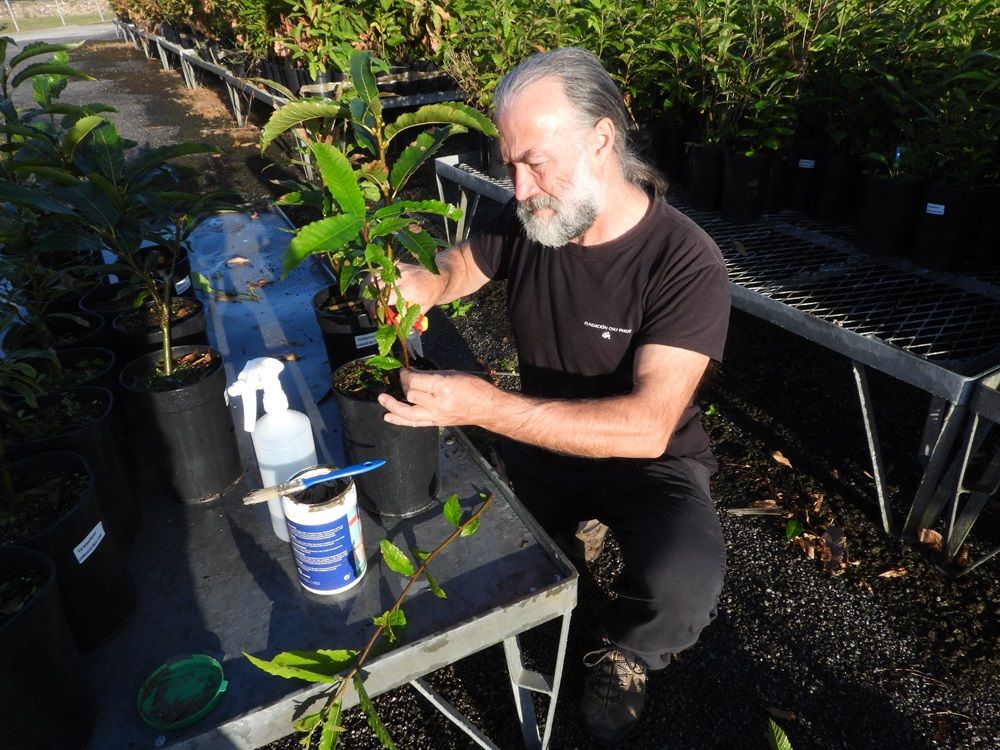
Removal of the suckers from the grafted sweet chestnuts within the framework of the LIFE Bears with future project. La Mata Forestry Nursery of the Principality of Asturias

The “Bears with Future” Project, co-financed by the European Union LIFE Project, will be carried out until 2025. It is coordinated by the Brown Bear Foundation in partnership with the Biodiversity Foundation (Ministry for Ecological Transition and Demographic Challenge), and the Natural heritage Foundation of the Castilla y León regional government. The Government of Asturias is co-financer, via the Directorate General for the Environment and Rural Planning, of the Department of Rural Development, Agriculture and Fisheries. Tierra Pura Foundation collaborates technically and co-finances the project.

Share this entry
  • Share on Facebook
  • Share on Twitter
  • Share on Pinterest
  • Share on LinkedIn
  • Share on Tumblr
  • Share on Vk
  • Share on Reddit
  • Share by Mail
https://m.fundacionosopardo.org/wp-content/uploads/2023/10/dscn9270-para-web.jpg 750 1000 EditorFOP https://m.fundacionosopardo.org/wp-content/uploads/2019/01/Fundacion_Oso_Logo_1.png EditorFOP2023-10-23 18:21:002023-12-26 18:25:18Review of the first plantings campaign of the LIFE Bears with Future project. October 2023

Pages

  • BEAR HOUSES
  • Become “Bears friend”
  • Bioeconomy: Chestnuts, Bears, and Rural Development
  • COEX
  • Cookies policy
  • Donations and legacies
  • FOOTPRINT Program
  • Form: become bears friend
  • HABITAT Program
  • Home
  • Legal Notice
  • LIFE Projects
  • Management body
  • Marco legal
  • Other LIFE Projects
  • Our objectives
  • Our team
  • Privacy Policy
  • Project LIFE bears with future
  • Proyecto LIFE Human Bear Coex
  • Publications
  • Results that leave a footprint
  • Supports
  • Under review
  • URSUS Program
  • URSUS Program
  • We are transparent

Categories

  • Actualidad
  • LIFE Bears with future
  • LIFE Human Bear Coex
  • Private fundations
  • Public administrations and other public entities
  • Socially Responsible Companies
  • Uncategorized

Archive

  • June 2026
  • June 2025
  • June 2024
  • April 2024
  • March 2024
  • December 2023
  • October 2023
  • September 2023
  • July 2023
  • May 2023
  • April 2023
  • February 2023
  • December 2022
  • October 2022
  • September 2022
  • August 2022
  • July 2022
  • June 2022
  • May 2022
  • March 2022
  • February 2022
  • December 2021
  • November 2021
  • October 2021
  • September 2021
  • August 2021
  • June 2021
  • March 2021

FUNDACIÓN OSO PARDO

c/ San Luis 17 4ºA.
39010 Santander – Cantabria
(España)

Tel: +34 942 23 49 00
Fax: +34 942 23 50 48
fop@fundacionosopardo.org

© 2024 FUNDACIÓN OSO PARDO

PRIVACY POLICY
COOKIES POLICY
LEGAL NOTICE

New seed collection of native species of interest to the brown bear. September...Study into the impact of climate change on the wild cherry and its effects on...

Scroll to top

We are using cookies to give you the best experience on our website.

You can find out more about which cookies we are using or switch them off in settings.

Powered by  GDPR Cookie Compliance
Privacy Overview

This website uses cookies so that we can provide you with the best user experience possible. Cookie information is stored in your browser and performs functions such as recognising you when you return to our website and helping our team to understand which sections of the website you find most interesting and useful.

Strictly Necessary Cookies

Strictly Necessary Cookie should be enabled at all times so that we can save your preferences for cookie settings.

If you disable this cookie, we will not be able to save your preferences. This means that every time you visit this website you will need to enable or disable cookies again.