• Twitter
  • Facebook
  • Instagram
  • Youtube
  • English English English en
  • Español Español Spanish es
ESPAÑOL
Fundación Oso Pardo
  • Home
  • WHO WE ARE
    • Management body
    • Our team
    • Our objectives
    • Results that leave a footprint
    • Legal regime
    • We are transparent
  • LEARNING ABOUT THE BROWN BEAR
    • The number of bears and where they live
    • Brown bear details
    • Not all brown bears are brown!
    • Tracks and signs
    • Bear landscapes
    • The repentant carnivore
    • Reproduction and family life
    • Hibernation
    • Bears and climate change
    • Encounters with bears
  • PROJECTS
    • LIFE Projects
      • Proyecto LIFE Human Bear Coex
      • Project LIFE bears with future
      • Other LIFE Projects
    • URSUS Program
    • HABITAT Program
    • Bear houses
    • FOOTPRINT Program
    • Bioeconomy: Chestnuts, Bears, and Rural Development
  • COLLABORATE WITH US
    • Donations and legacies
    • Become “Bears friend”
  • Publications
  • Supports
  • Search
  • Menu Menu

LIFE Bears with future

New seed collection of native species of interest to the brown bear. September 2023

25 September, 2023

New seed collection of native species of interest to the brown bear. September 2023

25 September, 2023/in LIFE Bears with future /by EditorFOP

The new seed collection campaign of the LIFE Bears with Future project was carried out over the whole summer. It commenced in July with the collection of wild cherry (Prunus avium) fruits. Subsequently, in August, alder buckthorn (Frangula alnus) fruits were collected, with the fruits of whitebeam (Sorbus aria) and rowan (Sorbus aucuparia) collected in September.

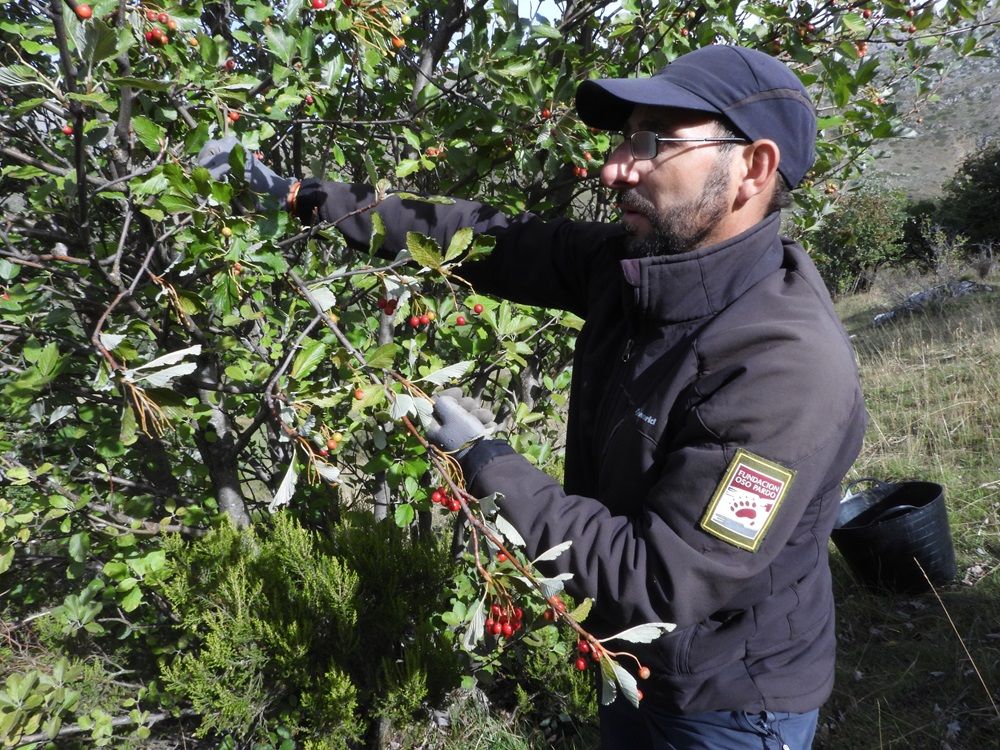
Fruit collection work was undertaken by Brown Bear Foundation field teams in bear areas showing compatible ecological characteristics with the planting terrain selected. The objective is to maintain the areas’ ecotypes and in consequence maximise the success of the plantations by being adapted to the action areas. Within these areas, the fruits of wild cherry, whitebeam and rowan were located within authorised collection sites, given that these are regulated species. The wild cherries were collected in León and Asturias and the rest of the species just in León. Specifically, 217 kg of wild cherries, 20 kg of alder buckthorn, 15 kilos of rowan and 58 kg of whitebeam fruits were collected under licence from from the corresponding authorities and in collaboration with the rangers from each of the areas to certify the seeds of the regulated species.

A member of a FOP patrol collecting whitebeam seeds. Photo FOP

The 77 kg of alder buckthorn, whitebeam, rowan and wild cherry fruits collected in León were sent to the Central Forestry Nursery of the Castilla y León regional government. The remaining 140 kg of wild cherry fruits collected in sources in Asturias were taken to the La Mata Forestry Nursery of the Principality of Asturias. In these nurseries, with which there are collaboration agreements, the fruits will be cleaned and prepared for the production of seedlings to reforest areas of interest under a climate change scenario and away from human settlement.

The wild cherry is a heavily used species by the brown bear at the end of spring and beginning of the summer, when other high energy trophic resources are scarce. It is a highly attractive delicacy for the bears since they have been feeding principally on leafy vegetation since coming out of hibernation.

The alder buckthorn is another highly attractive trophic resource for bears in the summer, while the whitebeam acquires major relevance during the autumn feeding period in years of poor fruiting of other species such as European beech and oak species. The same is true of apples (Malus sp.) and sweet chestnut (Castanea sativa), which have also been planted within the project’s framework.

Finally, although the fruits of rowan are not as attractive to bears as those species noted above, it is still a fruiting species of interest and which together with silver birch (Betula alba), another species also planted by the project, contribute to rapidly increase the high quality tree cover present in degraded areas.

To date within the project’s framework, 18,434 wild cherry, 6,958 alder buckthorn, 7,150 whitebeam, 3,400 rowan, 17,994 silver birch, 5,000 apple and 6,030 sweet chestnut trees, a proportion of the latter two species grafted with local varieties, have been planted to date.

The “Bears with Future” Project, co-financed by the European Union LIFE Project, will be carried out until 2025. It is coordinated by the Brown Bear Foundation in partnership with the Biodiversity Foundation (Ministry for Ecological Transition and Demographic Challenge), and the Natural heritage Foundation of the Castilla y León regional government. The Government of Asturias is co-financer, via the Directorate General for the Environment and Rural Planning, of the Department of Rural Development, Agriculture and Fisheries. Tierra Pura Foundation collaborates technically and co-finances the project.

Share this entry
  • Share on Facebook
  • Share on Twitter
  • Share on Pinterest
  • Share on LinkedIn
  • Share on Tumblr
  • Share on Vk
  • Share on Reddit
  • Share by Mail
https://m.fundacionosopardo.org/wp-content/uploads/2023/10/dscn9235-para-web.jpg 750 1000 EditorFOP https://m.fundacionosopardo.org/wp-content/uploads/2019/01/Fundacion_Oso_Logo_1.png EditorFOP2023-09-25 18:25:002023-12-26 18:28:25New seed collection of native species of interest to the brown bear. September 2023

Pages

  • BEAR HOUSES
  • Become “Bears friend”
  • Bioeconomy: Chestnuts, Bears, and Rural Development
  • COEX
  • Cookies policy
  • Donations and legacies
  • FOOTPRINT Program
  • Form: become bears friend
  • HABITAT Program
  • Home
  • Legal Notice
  • LIFE Projects
  • Management body
  • Marco legal
  • Other LIFE Projects
  • Our objectives
  • Our team
  • Privacy Policy
  • Project LIFE bears with future
  • Proyecto LIFE Human Bear Coex
  • Publications
  • Results that leave a footprint
  • Supports
  • Under review
  • URSUS Program
  • URSUS Program
  • We are transparent

Categories

  • Actualidad
  • LIFE Bears with future
  • LIFE Human Bear Coex
  • Private fundations
  • Public administrations and other public entities
  • Socially Responsible Companies
  • Uncategorized

Archive

  • June 2026
  • June 2025
  • June 2024
  • April 2024
  • March 2024
  • December 2023
  • October 2023
  • September 2023
  • July 2023
  • May 2023
  • April 2023
  • February 2023
  • December 2022
  • October 2022
  • September 2022
  • August 2022
  • July 2022
  • June 2022
  • May 2022
  • March 2022
  • February 2022
  • December 2021
  • November 2021
  • October 2021
  • September 2021
  • August 2021
  • June 2021
  • March 2021

FUNDACIÓN OSO PARDO

c/ San Luis 17 4ºA.
39010 Santander – Cantabria
(España)

Tel: +34 942 23 49 00
Fax: +34 942 23 50 48
fop@fundacionosopardo.org

© 2024 FUNDACIÓN OSO PARDO

PRIVACY POLICY
COOKIES POLICY
LEGAL NOTICE

Activities with the Mycological Associations and Federations of the Cantabrian...Review of the first plantings campaign of the LIFE Bears with Future project....

Scroll to top

We are using cookies to give you the best experience on our website.

You can find out more about which cookies we are using or switch them off in settings.

Powered by  GDPR Cookie Compliance
Privacy Overview

This website uses cookies so that we can provide you with the best user experience possible. Cookie information is stored in your browser and performs functions such as recognising you when you return to our website and helping our team to understand which sections of the website you find most interesting and useful.

Strictly Necessary Cookies

Strictly Necessary Cookie should be enabled at all times so that we can save your preferences for cookie settings.

If you disable this cookie, we will not be able to save your preferences. This means that every time you visit this website you will need to enable or disable cookies again.